House Clearance Victoria — Recycling and Sustainability
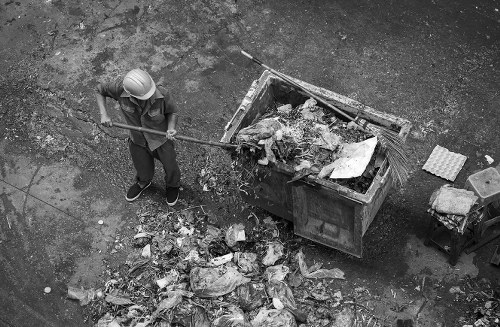 At House Clearance Victoria we prioritise an eco-friendly waste disposal area approach across every clearance. Our commitment to sustainable rubbish area practices means we plan each project with reuse, repair and recycling at the centre. We treat clearances not as waste events but as opportunities to divert materials from landfill, support local reuse channels and reduce the carbon footprint of removals. This page explains our targets, local partnerships and how our sustainable house clearance model works in the context of boroughs' waste separation schemes.
Our recycling targets and practical goals
We set a clear, measurable goal: a company-wide recycling percentage target of 75% by weight on all domestic clearances within 24 months. Achieving this involves route planning, on-site sorting and prioritising items for donation or repair. Key performance indicators we track include:
- Percentage of materials diverted from landfill
- Tonnes donated to reuse partners
- Vehicle emissions per job
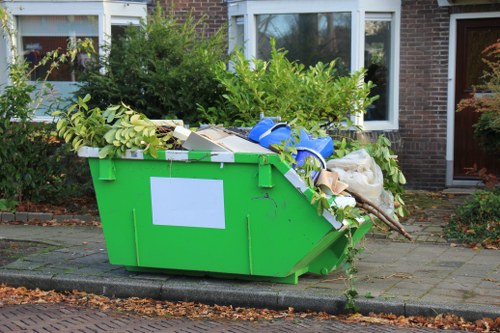 We work closely with local transfer stations and community recycling centres to ensure materials are handled correctly. Our team is familiar with municipal civic amenity sites, council transfer stations and specialist recycling depots across the boroughs we serve. That means: glass, paper, textiles, WEEE (electricals), metals and bulky furniture are routed to the correct processing streams in line with borough-specific waste separation policies.
Partnerships with charities are a cornerstone of our reuse-first policy. We have arrangements to redistribute usable items — from sofas and beds to kitchenware and books — to local furniture reuse charities, community groups and social enterprises. These collaborations reduce waste, support vulnerable households and extend the life of quality goods. Our typical charity partners include furniture reuse organisations, community centres and local redistributors that operate within the borough networks.
Low-carbon vans and greener logistics
 Our fleet is being transitioned to low-carbon vans: a mix of electric and hybrid vehicles plus efficient diesel models for longer runs. Fleet upgrades are paired with smarter route scheduling to reduce idling and empty runs. We monitor fuel use and CO2 emissions per clearance and apply continuous improvements to achieve a lower-emission clearance service. The result is a greener logistics model that supports a sustainable rubbish area ethos from collection to final processing.
House Clearance Victoria aligns operational practice with the boroughs' approach to waste separation: residents often separate recyclables at source (paper, mixed glass, cans, plastics, and food waste) and we aim to mirror this separation during clearances. Our crews perform on-site segregation where possible, preparing separate loads for transfer stations or direct charity pickup. Hazardous items such as batteries, solvents and asbestos-containing materials are identified and handled using compliant pathways to protect public health and the environment.
We also tailor recycling activity to local needs. In some boroughs, textiles and small electricals have specialist kerbside schemes — we consolidate these streams to make drop-offs efficient. In areas with strong furniture reuse programmes, we prioritise repair and donation over recycling. These small, localised adjustments increase overall diversion rates and strengthen our community relationships.
To support transparency we publish regular summaries of diversion rates, reuse tonnage and vehicle emissions. Our team sets quarterly targets and reports progress internally, using data to inform training and operational changes. Staff receive guidance on spotting items for reuse, and we maintain a database of charity partners and specialist processors to speed appropriate placements.
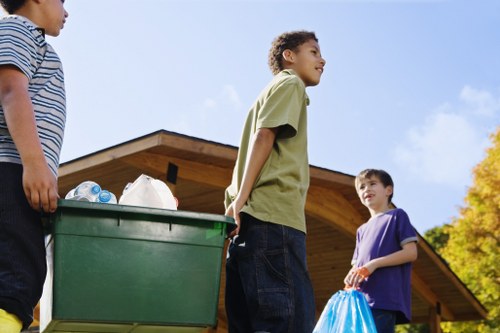 Infrastructure on-site is simple but effective: clear labelling of collection zones, washable reusable sacks for dry recyclables, and compacting strategies for bulky waste to reduce transfer frequency. For larger clearances we set up a temporary sustainable clearance zone that replicates an eco-friendly waste disposal area — this minimises cross-contamination and ensures high-quality recyclable outputs.
 Beyond operations, we invest time in community engagement and educational outreach, explaining the benefits of reuse and how local borough schemes work. Our aim is to leave properties cleared and communities informed, with as many items as possible given a second life. We believe a practical, measurable approach to recycling and sustainability strengthens local circular economies and reduces the environmental impact of house clearances.
House Clearance Victoria is committed to a greener future: through ambitious recycling percentage targets, cooperation with transfer stations and charities, and a low-carbon vehicle programme we deliver an ethical, sustainable rubbish area approach to every job. Our ongoing aim is to exceed local expectations for eco-friendly waste disposal and to continually improve the way we handle materials for people and the planet.